Pontypridd Golf Club — Course status and club enquiries
The situation
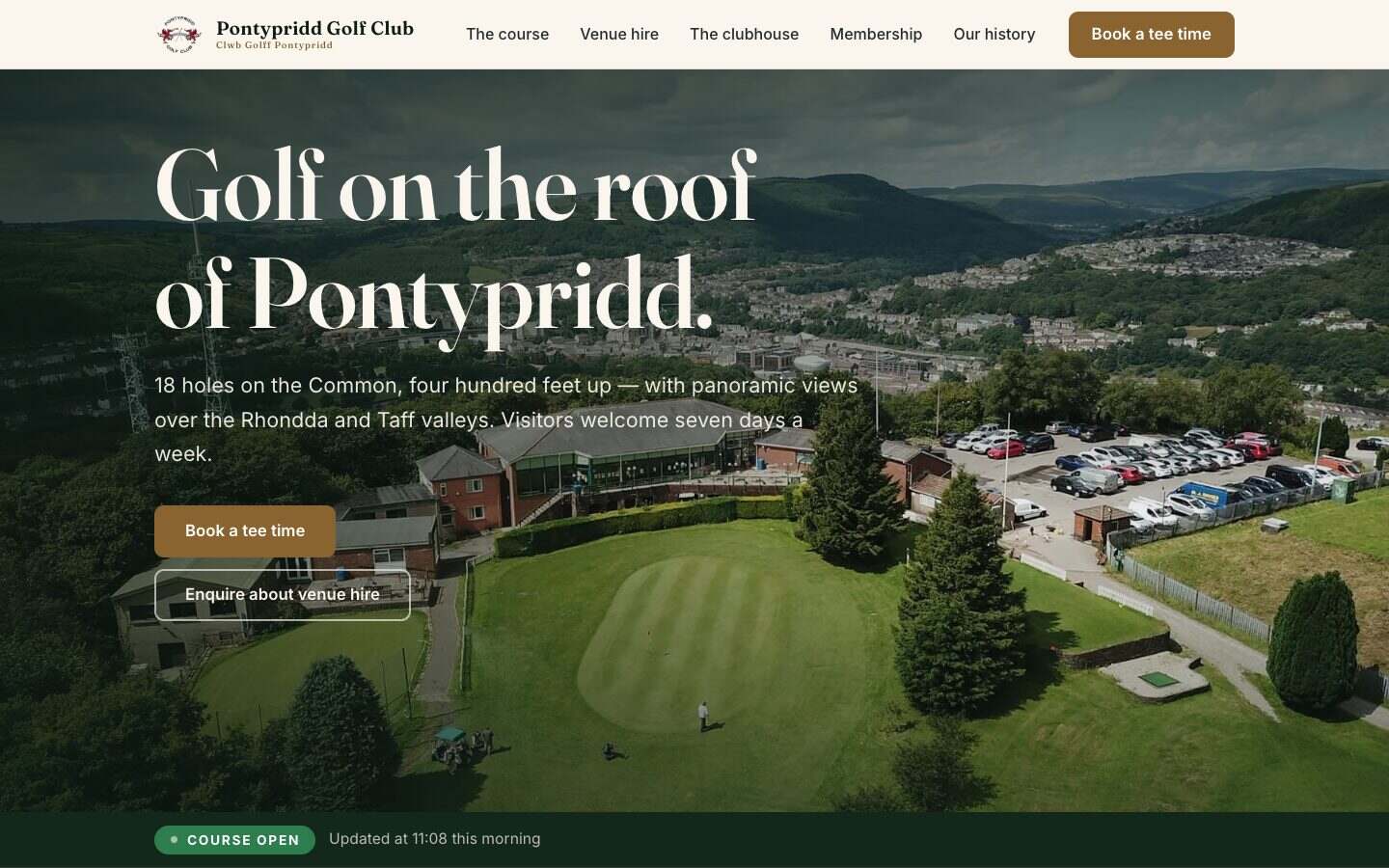
Pontypridd Golf Club has played on the Common, four hundred feet above the town, since 1905: nine holes when it opened, eighteen today.
The club's previous website sat on a domain registered in 2005 that the club did not control. By the time the new site went live, that domain no longer answered. A club with more than a century on the Common had no address on the web it could call its own.
Two questions the club could not answer online. Golfers want to know whether the course is open. Event bookers want to know whether the function room is available and how to ask. Course conditions meant ringing the clubhouse, and a room that seats 120 above the town had no enquiry route on the web. One should be answerable at a glance on a phone; the other should take a form, not a phone call.
Then there was the history. The club believed much of its written record had been lost with the old website; the page is gone and was never archived. A club that raised money for its course with a rugby match against the touring Wallabies, and rebuilt its clubhouse within a year of a fire, deserved better than a blank. And everything on the new site had to be true and the club's own: real photographs, a history that could be sourced, no stock imagery, no AI pictures, no invented claims.
What was built
The website includes a history page, a clubhouse section, venue-hire information and an enquiry form with event types to choose from. The photographer's written licence covers the event photography, and the club captain confirmed the hole captions.
The history page rebuilds 1905 to 1914 from Welsh newspapers digitised by the National Library of Wales, beside the club's archive film and an appeal for post-1919 material. The Welsh name, Clwb Golff Pontypridd, appears on every page. Underneath: static HTML, no framework, and a strict Content-Security-Policy with no inline scripts.
What it does now
The clubhouse team sets COURSE OPEN or COURSE CLOSED from a password-protected page on a phone. The public website displays that course status alongside the club's information.
Both enquiry forms send to the club secretary's inbox, with the visitor's email as reply-to when one is given. They work without JavaScript and use a honeypot field to screen submissions.
A successful confirmation follows acceptance by the email provider. If sending fails, the form shows the club's phone number and a 'Try again' button.