Pryce & Elliott — The Practice That Doesn't Exist
The situation
Pryce & Elliott is a private dental practice in Cardiff Bay that does not exist. No patients, no clinicians, no premises: it is a self-initiated Studio 72 concept, built to show what we would ship for a real private practice.
The aim was a dental website with films controlled by scrolling and a complete page for visitors who prefer less motion. The content also needed to work beyond the opening scene: treatments, care pathways and practical information for a first visit.
The fictional practice needed to be clear throughout. Invented clinician names, GDC numbers or patient reviews could mislead visitors, so the build needed visible disclosures alongside the treatment and booking content.
The content also needed to be replaceable. A real practice should be able to supply its treatments, team details and photography without a rewrite of the film engine. That shaped the single-file content model.
What was built
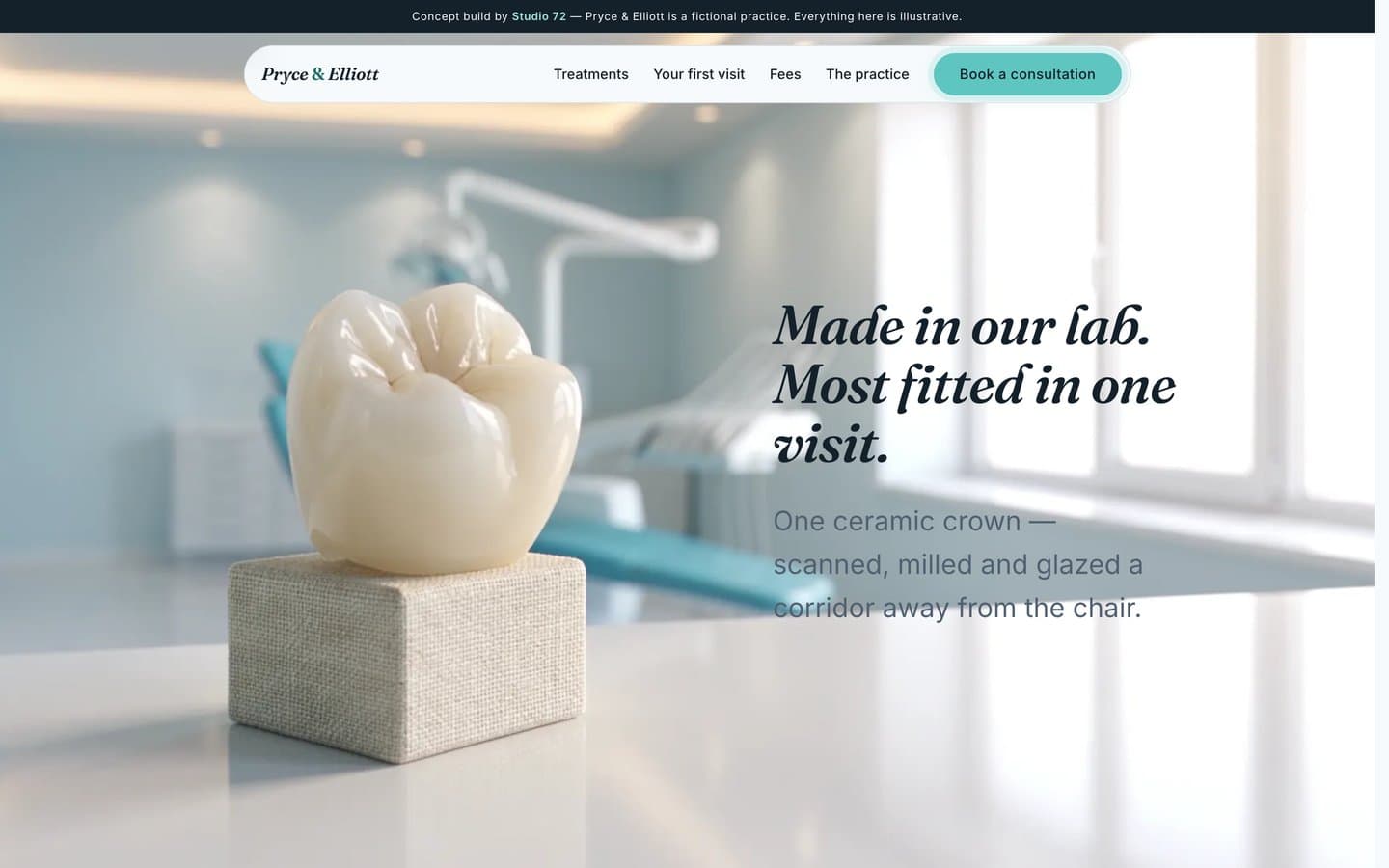
The arrival film moves through the front door, past reception and into the surgery as it wakes. Visitors control the frames by scrolling, with copy appearing alongside the film. A second scene turns a ceramic crown on a linen plinth. The page also has selectable care pathways, a first-visit sequence and a comfort menu for nervous patients.
A disclosure ribbon sits on every page; the footer repeats it. No invented clinicians, GDC numbers or patient reviews. AI imagery and fees are labelled illustrative, the phone number is Ofcom's drama range marked 'does not connect', the map is a pinless area view — because the practice does not exist — and the concept site uses noindex. Automated checks cover its disclosure rules.
The booking form sends requests to HubSpot and uses Resend for email, with failure states and a success message that repeats the disclosure. The site uses a strict Content-Security-Policy and reduced-motion support. Its sections read from one data file, keeping the content separate from the film engine.
What it does now
Visitors can follow the arrival and crown scenes, choose a care pathway and read the first-visit information. Visitors who prefer less motion get a complete page without the film animation.
The result is a working concept that remains clearly labelled as fictional. It shows the page structure, content model and request handling a dental website can use. It does not represent an operating practice or evidence of patient bookings.